





Tariffs and a deepening China slowdown overshadow strong North America momentum, testing investor confidence in the brand’s turnaround.


A $1.5 billion tariff hit and sharp weakness in Greater China overshadow solid North America growth, sending the sneaker giant’s stock sharply lower
Nike’s long-anticipated turnaround hit a major setback this week as the company’s shares plunged nearly 10%, rattled by shrinking profits, mounting tariff pressures, and a pronounced slowdown in China — one of its most critical global markets.
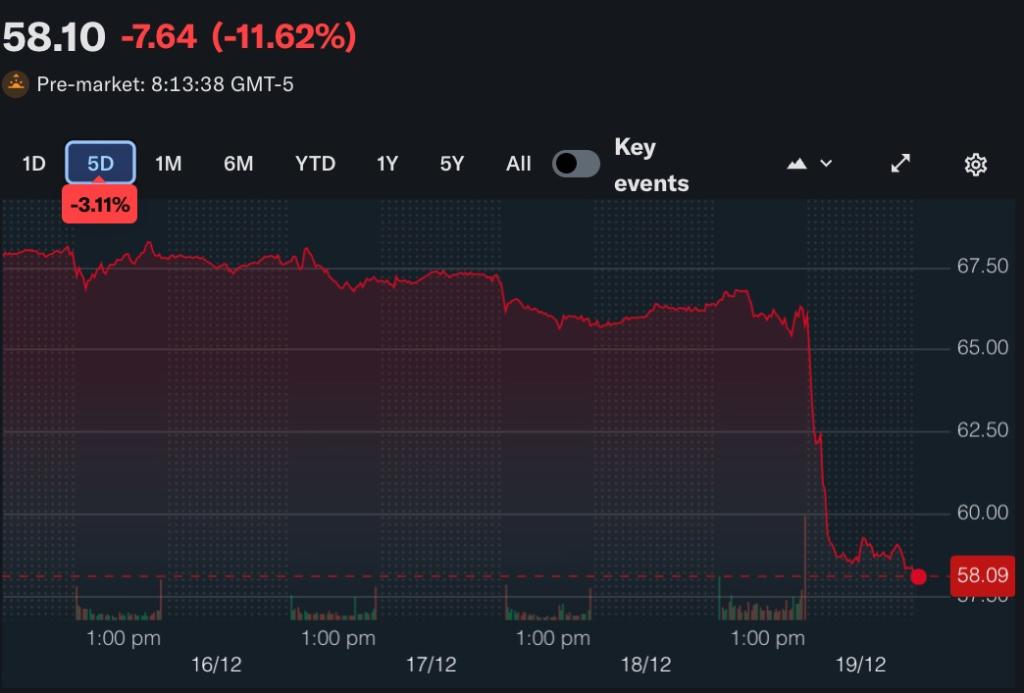
Shares of the sportswear giant fell to around $58 in premarket trading on Friday, down from a prior close near $65, after investors reacted to a steep earnings decline and continued margin pressure. The sell-off came despite modest revenue growth, highlighting concerns that macroeconomic headwinds and regional imbalances are complicating Nike’s recovery story.
For the second quarter of fiscal year 2026, Nike reported revenue of $12.4 billion, up just 1% year over year. Net income, however, dropped sharply by 32% to $792 million, while diluted earnings per share fell to $0.53 from $0.78 a year earlier.
Gross margin declined by 300 basis points to 40.6%, pressured by higher US tariffs and excess inventory in China. The company warned that newly imposed tariffs are expected to add approximately $1.5 billion in annualized incremental product costs — a significant drag on profitability.
“I want to state it very clearly: margin expansion is a top priority for me and my leadership team,” CEO Elliott Hill said during the earnings call, acknowledging the scale of the challenge ahead.
While management described the company as being “in the middle innings” of its comeback, Hill cautioned that progress is uneven across regions — with China at the top of the concern list.
Nike’s direct sales in China fell 18% during the quarter, including a steep 36% drop in Nike Digital, its e-commerce business. Overall revenue in the region plunged 17% to $1.4 billion, while EBIT collapsed 49%, underscoring the severity of the slowdown.
Executives attributed the weakness to declining store traffic, poor sell-through, and an overreliance on promotions that have diluted Nike’s premium brand positioning in the market.
In contrast, North America continued to serve as a bright spot and a blueprint for Nike’s broader turnaround. Revenue in the region rose 9% to $5.6 billion, driven by a 24% surge in wholesale sales that offset a 16% decline in Nike Digital.
Wholesale revenue grew 8% companywide, and Nike’s running footwear and apparel category stood out once again, posting growth of more than 20% for a second consecutive quarter. The category delivered double-digit gains across Nike-owned stores, digital platforms, and wholesale channels.
“The geography that is leading the way for Nike right now is North America,” Hill told investors. “As our largest business, that’s where much of our focus has been.”
Nike is also intentionally shrinking parts of its portfolio as it refocuses on innovation and premium positioning. The company expects to cut more than $4 billion in classic footwear franchises from peak levels by the end of the fiscal year, creating an estimated $550 million top-line headwind in the quarter.

Chief Financial Officer Matt Friend framed the results as a sign of resilience amid deliberate repositioning. “Our second quarter results demonstrated the resilience of our portfolio, with modest year-over-year reported top-line growth, despite managing headwinds from the actions we have taken to reposition our business,” he said.
Despite strength in North America, investors remain wary as tariff costs, margin compression, and China’s prolonged slump cloud Nike’s near-term outlook. With shares down more than 11% in early trading at one point, the results signal that while the comeback narrative is intact, the road ahead may be longer — and more volatile — than many had hoped.

The road to recovery is proving more difficult than expected for Nike, as the company grapples

In a significant misstep within the rapidly evolving artificial intelligence sector, Anthropic is scrambling to contain

In a move that could redefine global capital markets, Elon Musk’s SpaceX has confidentially filed for

In the world of entrepreneurship, access to capital can determine whether a promising idea grows into

A major dispute between the U.S. government and one of the world’s leading artificial intelligence companies