






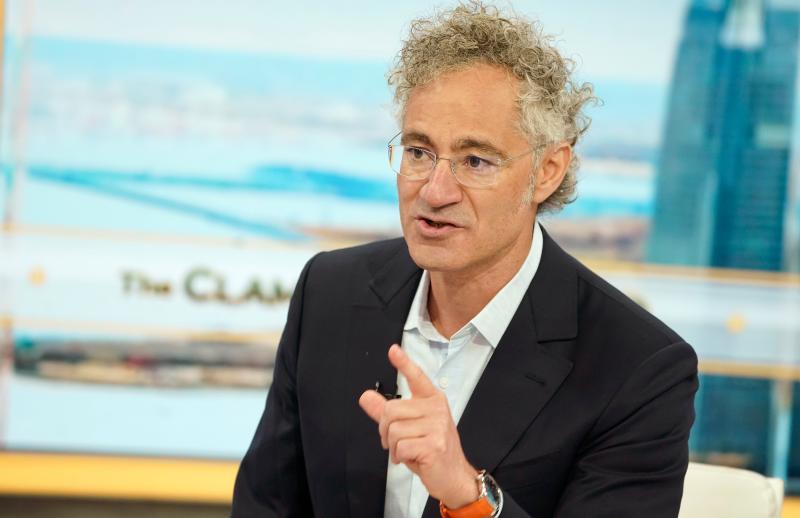
The future of artificial intelligence may not belong exclusively to the handful of technology giants developing the world’s most advanced AI models. According to Alex Karp, CEO of Palantir Technologies, the next phase of the AI revolution could instead be defined by something he calls “AI sovereignty”—a world in which companies own and control the artificial intelligence they use.
Karp’s argument comes at a time when public confidence in the AI industry remains remarkably low. An Anthropic and YouGov poll from December 2025 found that only 15% of Americans trust AI companies to make decisions about the technology’s development and use.
That lack of confidence has fueled concerns that artificial intelligence could concentrate enormous amounts of economic power among a small group of technology companies and executives.
Karp believes there is another path.
Rejecting the Concentration of AI Power
Speaking at a Palantir company boot camp last week, Karp warned against a future in which the economic value created by AI becomes concentrated in Silicon Valley.
“We cannot have a society where all the value goes to 2,500 people sitting in Silicon Valley. That just will not work, and no one’s going to put up with it.”
His comments reflect Palantir’s broader argument that AI should empower businesses and workers rather than make them dependent on a small number of frontier AI laboratories.
Palantir, a Miami-based software company known for developing AI and data platforms for governments and businesses, is increasingly positioning itself as an alternative to the conventional model of AI consumption.
Rather than encouraging companies to permanently outsource their intelligence and data infrastructure to major AI laboratories such as Google DeepMind, OpenAI, and Anthropic, Palantir wants organizations to retain ownership and control.
Karp has previously described businesses that become excessively dependent on frontier AI companies as potentially becoming “vassal states of the language labs.”
What Does AI Sovereignty Mean?
At the center of Palantir’s strategy is a straightforward proposition: companies should own their AI systems and retain control over their data.
Instead of simply paying an AI laboratory for access to its models, businesses could deploy AI tools that they control themselves. This approach would give organizations greater authority over how their data is processed, how AI systems are used, and how their technology evolves.
Kevin Kawasaki, Palantir’s Head of Business Development, summarized the philosophy by emphasizing ownership:
“Your data, your model, not ours, not someone else’s.”
The concept is particularly significant for organizations handling sensitive corporate, government, manufacturing, healthcare, or financial information. Under Palantir’s vision, businesses would not have to surrender control of valuable data simply to benefit from advanced AI capabilities.
Moving Beyond the “AI Doomer” Narrative
Palantir is also challenging what it sees as an overly pessimistic narrative surrounding artificial intelligence.
Some prominent AI leaders, including Dario Amodei, CEO of Anthropic, have warned about the possibility of AI dramatically disrupting employment and creating profound economic and social consequences.
Palantir executives argue that the reality experienced by workers using AI today can look very different from the more extreme scenarios frequently discussed by technology leaders.
Lead Palantir Architect Chad Wahlquist pointed to nurses, factory workers, and other employees who are already using AI in practical workplace settings.
According to Wahlquist, speaking directly with these workers reveals a different picture from the fear-driven narratives sometimes associated with the future of AI.
The argument is not that AI carries no risks, but that the technology’s impact should also be evaluated through the experiences of people actually using it to perform their jobs.
The Battle Against “Token-Maxing”
Palantir is taking its philosophy a step further by challenging another feature of the modern AI economy: the emphasis on consuming increasingly large quantities of AI processing.
Many AI companies generate revenue based on usage, meaning customers may pay more as they process more data or use more AI tokens.
Palantir executives refer to this dynamic as “token-maxing.”
“Everyone else is focused on consumption. That’s how they get paid,” Wahlquist said.
Palantir claims its business model is different because it focuses on outcomes rather than encouraging customers to maximize AI usage.
“We get paid on outcomes. That is the core differentiator about us to everyone else,” Wahlquist said.
The distinction reflects a broader question facing the AI industry: should companies be rewarded for how much AI they consume, or for the measurable value that AI creates?
Palantir is betting heavily on the latter.
A Nine-Point Vision for AI Sovereignty
Over recent months, Palantir has intensified its push around the concept of sovereignty. The company has unveiled a nine-point manifesto and launched a boot camp designed to demonstrate how organizations can implement AI while retaining control of their data and technology.
The strategy represents an attempt to change the conversation around AI—from dependency to ownership.
Instead of viewing AI as a service that businesses rent from technology giants, Palantir wants organizations to view AI as infrastructure they can control, govern, and integrate into their own operations.
“If You’re Renting It, You’re Not Running Your Business”
For Kawasaki, the issue ultimately comes down to corporate independence.
“Sovereignty means you own the right to run your business,” he explained.
He warned that if an AI laboratory can access a company’s data, train on it, and potentially use resulting capabilities in ways that benefit competitors, the business may no longer have complete control over its own operations.
“If an AI lab can access your data, train on it, and sell that model to your competitors, you’re not running your business. You’re renting it,” Kawasaki said.
That philosophy is particularly relevant as AI becomes embedded deeper into core business functions—from supply chains and manufacturing to customer service, research, cybersecurity, and strategic decision-making.
An AI Future Built Around Ownership
Palantir’s vision ultimately challenges one of the defining assumptions of the current AI boom: that the most powerful AI systems must necessarily be controlled by a small number of frontier laboratories.
Karp argues instead for a more distributed AI economy—one where large enterprises, smaller companies, governments, and other organizations retain sovereignty over their technology and information.
The approach also reflects a distinctly American framing of technological independence, with Palantir presenting ownership and control as fundamental principles of economic freedom.
As artificial intelligence becomes increasingly important to global competitiveness, the question may no longer be simply who has the most powerful AI model.
It could become who controls the AI that runs their business.
For Palantir, that distinction is the foundation of its vision for the next generation of artificial intelligence: your data, your model, your decisions—and ultimately, your sovereignty.