





Elon Musk’s satellite network steps in amid power and connectivity outages, highlighting Starlink’s growing geopolitical role during conflict and political upheaval.
Elon Musk’s satellite internet service, Starlink, has begun offering free broadband access across Venezuela in the immediate aftermath of a dramatic U.S. military raid that led to the capture of longtime leader Nicolás Maduro, marking another high-profile moment where private technology infrastructure intersects with global geopolitics.
In a blog post published Sunday, Starlink—owned by Musk’s aerospace company SpaceX—announced it was adding service credits to both active and inactive Starlink accounts in Venezuela. These credits can be used to access free internet service through February 3, providing a crucial communications lifeline as parts of the country grapple with outages following the operation.
The move came as Venezuela’s capital, Caracas, along with neighboring Miranda state, reportedly experienced widespread power and internet disruptions in the wake of the “large-scale strike” carried out by U.S. forces.
“We are actively monitoring evolving conditions and regulatory requirements,” Starlink said in a statement, underscoring the fluid and uncertain situation on the ground. The company added that while there is currently no timeline for local purchase availability of Starlink equipment, any updates would be communicated through official channels.
Starlink delivers high-speed internet via a constellation of low-Earth orbit satellites built and launched by SpaceX. While users must purchase dedicated hardware to connect, the temporary service credits remove the cost barrier for connectivity during the current crisis. It remains unclear whether the free access will be extended beyond February 3.
SpaceX has not yet responded to requests for comment regarding the initiative.
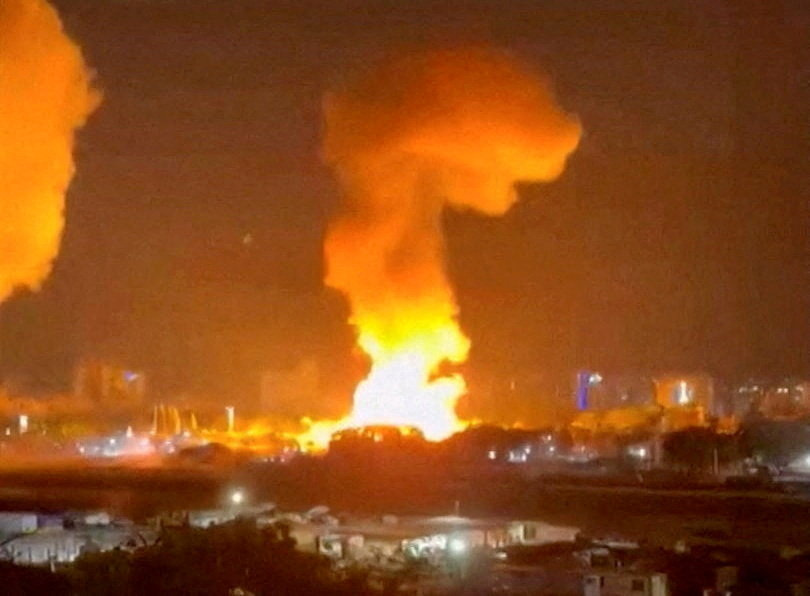
The U.S. raid on Saturday primarily targeted Caracas, though strikes were also reported in the states of Miranda, Aragua, and La Guaira. Images of smoke and explosions circulating from the capital underscored the severity of the operation and its immediate impact on civilian infrastructure.
On Monday, Nicolás Maduro and his wife, Cilia Flores, made their first court appearance in the United States, pleading not guilty to federal charges including narco-terrorism conspiracy, cocaine importation conspiracy, and weapons offenses.
Former President Donald Trump, who announced the operation, said the U.S. would effectively “run” Venezuela until a safe transition to new leadership could be secured. He added that American companies would help repair the country’s oil infrastructure and “start making money.” Trump also revealed that Vice President Delcy Rodríguez had been sworn in as interim president, issuing a stark warning that failure to cooperate would result in consequences “probably worse” than those faced by Maduro.
This is not the first time Starlink has stepped into a conflict zone. In 2022, the service was rapidly deployed in Ukraine after Russia’s invasion severely damaged the country’s communications networks. Ukrainian officials have since praised Starlink as a critical tool for both civilians and military operations during the war.
However, the service’s expanding role has also raised concerns. Critics warn that a single private company wielding such influence over connectivity in conflict zones could consolidate unprecedented power. Musk himself acknowledged these tensions in 2023, when he said he denied a Ukrainian request to extend Starlink coverage to Sevastopol, citing concerns about making SpaceX “explicitly complicit in a major act of war and conflict escalation.”
These concerns have drawn political attention in Washington, where a U.S. Senate committee has examined the implications of one private citizen having outsized influence over foreign conflicts and communications infrastructure.
Beyond war zones, Starlink has been used in countries such as Iran to help bypass government-imposed internet censorship, further cementing its reputation as both a technological and political force.
As Starlink’s dominance in satellite broadband grows, global competitors are racing to catch up. China, in particular, has accelerated efforts through initiatives like Shanghai-based Qianfan—also known as SpaceSail—as well as Beijing’s state-owned space programs, all aiming to deploy rival low-orbit satellite networks.
In Venezuela, for now, Starlink’s free internet service offers a rare point of stability amid political upheaval and infrastructural strain. More broadly, it underscores how modern conflicts are no longer shaped solely by military power and diplomacy, but also by who controls the digital lifelines that keep nations connected when everything else goes dark.

The road to recovery is proving more difficult than expected for Nike, as the company grapples

In a significant misstep within the rapidly evolving artificial intelligence sector, Anthropic is scrambling to contain

In a move that could redefine global capital markets, Elon Musk’s SpaceX has confidentially filed for

In the world of entrepreneurship, access to capital can determine whether a promising idea grows into
A major dispute between the U.S. government and one of the world’s leading artificial intelligence companies