





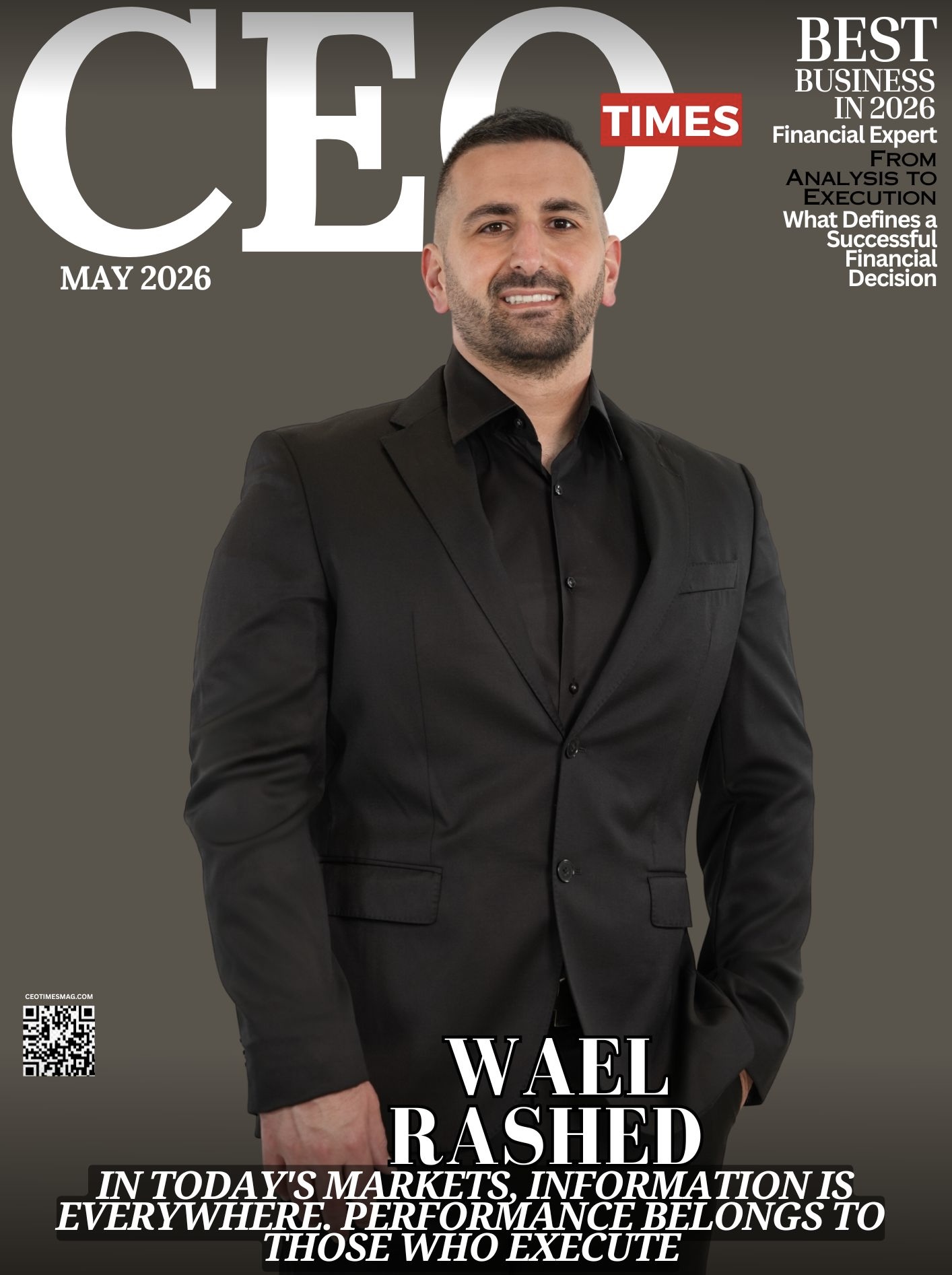
In a financial world saturated with information, the assumption that knowledge alone creates advantage is becoming increasingly outdated. Markets today move faster than ever. Economic data is released in real time, institutional research is accessible globally, and commentary never stops. Yet despite unlimited access to information, most investors continue to struggle with consistency, discipline, and long term performance. For Wael Rashed, the explanation is clear: modern investing is no longer about access to information it is about the ability to execute under pressure.
In this exclusive conversation, Wael Rashed explains why discipline has become the most valuable asset in finance, how investors fall into the “execution gap,” and what separates professional decision makers from emotional market participants.
Q: In today’s markets, what actually creates a financial advantage?
According to Wael Rashed, the answer has changed dramatically over the last decade. Years ago, information itself created an edge, he explains. Today, information is everywhere. The real advantage is the ability to act on it with clarity and precision.
He believes modern investors often confuse information consumption with financial competence. Markets reward decision quality not the amount of data someone absorbs. In today’s markets, the real advantage is no longer information. It is the ability to act on it with clarity and precision. For Rashed, this distinction is critical. Investors today monitor inflation, central bank policy, liquidity conditions, earnings reports, and geopolitical developments constantly. Yet many still fail to translate insight into measurable performance. The issue, he says, is not a lack of knowledge. It is a lack of structured execution.
Q: Why do so many investors struggle despite having access to so much information?
Wael Rashed points to what professionals in finance often call the Execution Gap the distance between understanding what should be done and actually doing it effectively under live market conditions. In markets, the greatest cost is rarely being wrong,” he says. “It is knowing what to do and failing to do it.
He identifies three common patterns behind this problem:
- hesitation despite sufficient clarity
- emotional reactions during volatility
- absence of a disciplined risk framework
According to Rashed, many investors become trapped in perpetual analysis. They continue searching for additional confirmation, waiting for perfect certainty before acting. But markets rarely offer complete visibility.Information is abundant. Judgment is scarce. That is where performance is built.
He believes professional investors understand something retail participants often overlook: execution matters more than intellectual complexity.

Q: What defines a successful financial decision?
For Wael Rashed, successful investing is not based on prediction. It is built on structure. He explains that high-quality financial decisions are typically the result of three integrated disciplines: analytical clarity, risk precision, and execution discipline.
Analytical Clarity
Rashed emphasizes that successful investors are not the ones processing the most information. They are the ones identifying the most relevant information. The advantage is not in seeing more. It is in identifying what matters first.
He explains that professional decision-makers focus primarily on variables that materially influence markets liquidity conditions, capital flows, institutional positioning, and macroeconomic direction. The objective is not to consume more information, he says. It is to filter noise and isolate signal.
According to Rashed, this ability to simplify complexity is one of the defining characteristics of experienced investors.
Risk Precision
When discussing risk management, Rashed takes a position that differs from many traditional perspectives. Risk management is not protection from volatility, he explains. “It is preparation for opportunity. He argues that sustainable financial performance is not determined by how often an investor is correct, but by how effectively they preserve capital when they are wrong. For him, risk management is not merely defensive it is strategic. It creates resilience during uncertainty while preserving flexibility when opportunities emerge. This includes disciplined asset allocation, maintaining liquidity, and balancing growth exposure with defensive positioning. Markets will always involve uncertainty,he says. The question is whether your structure allows you to survive volatility and still remain positioned to act.
Q: How important is execution discipline in investing?
Wael Rashed describes execution as the point where strategy becomes reality. Execution is the moment strategy becomes performance. He believes even sophisticated market analysis becomes meaningless without disciplined implementation. Strategies often fail not because they are flawed intellectually, but because investors abandon them emotionally. Execution discipline is the ability to remain consistent under pressure,” he explains. “That is what separates professionals from emotional participants. According to Rashed, the modern market environment rewards repeatability and consistency far more than occasional brilliance.
Q: Do markets reward intelligence?
Rashed challenges one of finance’s most persistent assumptions that superior outcomes are primarily driven by superior intelligence. Markets do not consistently reward the most intelligent participants, he says. They reward the most disciplined operators. He explains that intelligence can generate insight, but discipline determines whether insight is implemented effectively. This becomes especially visible during periods of instability when liquidity tightens, monetary policy shifts, and market sentiment weakens. In unstable environments, discipline becomes measurable, he says. That is where long-term investors distinguish themselves.
Q: How should investors think during uncertainty?
For Wael Rashed, the strongest investors operate more like leaders than spectators. They do not wait for complete certainty or perfect timing. Instead, they make calibrated decisions while managing risk intelligently. Professional investing is not the pursuit of certainty, he explains. It is the disciplined management of uncertainty. He believes the ability to make high-quality decisions under pressure is ultimately what defines long-term financial performance.
Final Perspective
As financial markets become increasingly complex, Wael Rashed believes the future belongs not to those who consume the most information, but to those who can execute with consistency, structure, and emotional control. For him, the defining principle of investing remains simple:
Analysis informs the decision. Execution defines the result.