





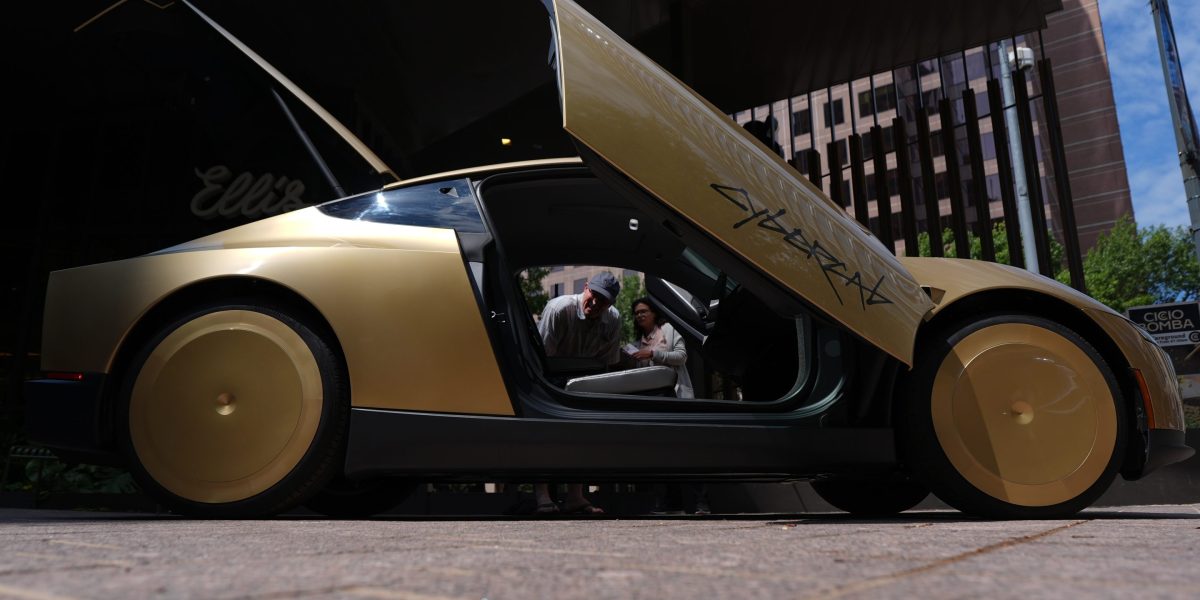
Tesla shares fell nearly 6% on Friday, closing at $354.08, after U.S. federal regulators opened an investigation into whether the electric vehicle maker properly certified its new Cybercab autonomous robotaxi.
The investigation, launched by the National Highway Traffic Safety Administration (NHTSA), focuses on the process and technical data Tesla used to demonstrate compliance with federal motor vehicle safety standards for up to 1,000 Cybercabs.
The regulatory scrutiny comes as Tesla continues to place autonomous driving at the center of its future strategy, making the Cybercab an important part of the company’s ambitions for a driverless transportation network.
NHTSA Examines Tesla’s Certification
NHTSA is investigating the basis for Tesla’s Cybercab certification, including the extent to which the company determined that certain federal safety standards did not apply to the vehicle.
The agency’s review is particularly significant because of the Cybercab’s unconventional design.
Unlike traditional vehicles, the autonomous robotaxi lacks permanently attached conventional manual controls. According to NHTSA, that includes a steering wheel, brake pedal, accelerator pedal and mirrors.
The absence of these familiar controls raises questions about how the vehicle was evaluated under existing federal safety requirements and whether Tesla’s certification process appropriately addressed those differences.
A Robotaxi Without Traditional Controls
The Cybercab represents a major departure from the conventional automobile.
Tesla has designed the vehicle around autonomous operation rather than human driving, eliminating controls that have traditionally been considered essential components of a motor vehicle.
That design is central to Tesla’s vision of autonomous transportation, but it also creates regulatory challenges.
Existing vehicle safety standards were developed largely around conventional automobiles operated by human drivers. As autonomous technology advances, regulators must determine how those rules should apply to vehicles designed to operate without traditional driver controls.
The NHTSA investigation could therefore have implications beyond Tesla, potentially helping shape how regulators approach future autonomous vehicles.
Tesla’s Autonomous Fleet in Texas
Tesla’s autonomous vehicle presence is already growing in Texas.
State records showed 420 autonomous Tesla vehicles registered in Texas as of Friday morning, including 45 Cybercabs.
The numbers underscore the pace at which Tesla is expanding its autonomous vehicle operations and why regulatory oversight is becoming increasingly important.
As more autonomous vehicles operate on public roads, questions surrounding certification, safety standards and the responsibilities of manufacturers are likely to receive greater attention.
The Legal and Regulatory Question
Under existing law, fully self-driving vehicles do not necessarily require the same regulatory treatment when they include required human controls such as steering wheels, brake pedals or mirrors.
The Cybercab’s lack of those conventional features makes its certification particularly important.
NHTSA is examining not only the vehicle’s technical characteristics but also Tesla’s reasoning for determining which federal standards applied and which may not have been applicable.
The investigation does not, by itself, establish that Tesla violated federal law or safety requirements. Instead, it represents a regulatory examination of whether the certification process and supporting technical information were appropriate.
Tesla Faces Pressure Over Its Robotaxi Strategy
Tesla did not immediately respond to a request for comment regarding the investigation.
The regulatory review arrives at a critical time for the company as it increasingly promotes autonomous vehicles as a major part of its future.
The Cybercab is intended to support Tesla’s broader robotaxi ambitions, with the company envisioning a transportation model in which vehicles can operate without human drivers.
For that strategy to succeed, however, Tesla must navigate more than technological challenges. Regulatory approval, safety compliance and public confidence will be equally important.
Any uncertainty surrounding the Cybercab’s certification could therefore become a significant issue for the company as it works to expand autonomous operations.
Investors React to the Investigation
The nearly 6% decline in Tesla shares reflects the sensitivity surrounding the company’s autonomous-driving ambitions.
Tesla has long presented self-driving technology as a crucial part of its future growth story. As a result, regulatory scrutiny of one of its most visible autonomous vehicles could attract considerable attention from investors.
The Cybercab is not simply another addition to Tesla’s vehicle lineup. It represents the company’s attempt to redefine how people may use automobiles in the future.
That makes the regulatory framework surrounding the vehicle particularly important.
A Defining Test for Autonomous Transportation
The NHTSA investigation highlights a broader challenge facing the autonomous vehicle industry.
As companies develop vehicles that can operate with little or no human intervention, regulators must adapt existing safety frameworks to technologies that were not contemplated when many of those rules were established.
Tesla’s Cybercab sits at the forefront of that transition.
Its steering-wheel-free design raises fundamental questions about how safety standards should apply when there is no expectation that a human occupant will take control.
The outcome of the investigation could help clarify how regulators approach similar vehicles and technologies in the years ahead.
For Tesla, the stakes are equally significant. The company will need to demonstrate that its autonomous technology can satisfy evolving regulatory requirements while maintaining investor and public confidence.
As the Cybercab moves toward wider deployment, its success will depend not only on Tesla’s ability to build a fully autonomous vehicle, but also on its ability to navigate the complex safety and regulatory landscape surrounding the future of transportation.
Related Articles