






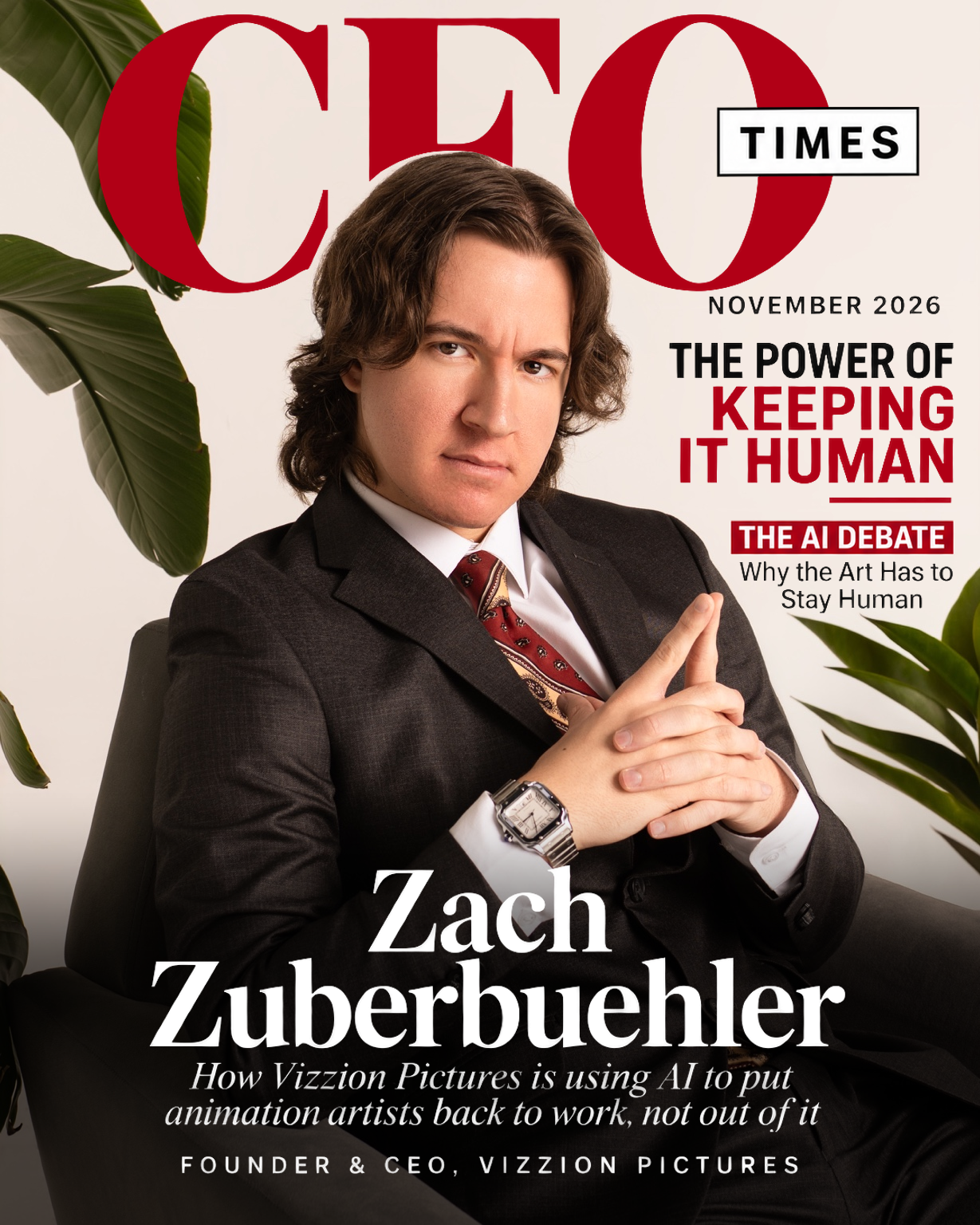
At 24, the founder of Vizzion Pictures is betting that AI can make animation faster without taking the artists out of it.
The animation industry is arguing about AI, and most of the argument comes down to two camps. One side wants to ban it. The other wants to automate everything. Vizzion Pictures founder and CEO Zach Zuberbuehler thinks both sides are missing the point.
“AI is coming to animation whether anyone likes it or not, because this industry follows the bottom line,” he says. “So the question isn’t whether it gets used. It’s who’s in charge when it does. Our answer is simple: keep the art human, automate the BS.”
That line has become the operating rule at Vizzion Pictures, the production company Zuberbuehler founded to develop and produce animated pilots for creators and IP holders.
Zuberbuehler didn’t come up through business school. He came up through the voice booth. As a voice actor, he spent his early career bringing other people’s characters to life, and he started to want more.
“I loved voicing characters, but I wanted to tell my own stories,” he says. “The problem is that animation is one of the most expensive art forms there is. Most creators never get past the pitch because nobody will fund a pilot that costs that much to make.”
That gap became the business. Vizzion Pictures produces everything from short sizzle reels to full pilots for creators who own a story but lack a studio. The goal is to give independent creators something real to show buyers.
Vizzion Pictures draws a clear line in its process. People write the scripts. People design and draw the characters. People perform the voices and direct every scene. AI is used as a tool for one job: adding motion, the slow and expensive part of animation that keeps most projects from ever being finished.
“Nobody watches a cartoon for the in-between frames,” Zuberbuehler says. “They watch for the characters, the jokes, the performances, the world. That’s the part that has to come from a person. The motion is labor, and that’s where the tool belongs.”
He argues the result creates work rather than eliminating it. Faster production means more shows get made, and more shows mean more writers, artists, voice actors and directors get hired. “If a pilot takes weeks instead of years, a lot more creators get their shot,” he says. “That’s more jobs for artists, not fewer.”
Zuberbuehler tested the model on himself first. For Smoke & Mirrors, an adult animated noir set in 1947 New York, he animated the 22-minute pilot himself in five weeks. Every clip in the finished pilot passed through his hands.
Then he made sure he wasn’t the only one who could do it. He trained his team on the full production process, and Head of Production Grady Evans now runs client productions on his own. “A studio that depends on one person isn’t a studio,” Zuberbuehler says. “I wanted a team that could deliver without me in the room.”

Vizzion Pictures is now applying that pipeline to other creators’ work. Its slate includes an animated adaptation of Grease Monkey, the science fiction comic series by Tim Eldred, which the company is working to bring to screens in 2027.
Zuberbuehler’s ambition is bigger than one show. He wants Vizzion Pictures to be the studio independent creators turn to when they’re ready to take a story from the page to the screen.
“Every great show starts with one person who had an idea nobody else could have had,” he says. “Technology should help that person get their story made. It should never replace them. That’s the line we hold, and it’s the line I think the whole industry is going to need.”
For a founder who started out lending his voice to other people’s characters, the mission is personal. He’s building the studio he wished existed when he started.
Learn more at vizzionpictures.com.

Tesla shares fell nearly 6% on Friday, closing at $354.08, after U.S. federal regulators opened an
OpenAI CEO Sam Altman has pushed back against growing concerns over the environmental impact of artificial

Lululemon’s turnaround has become increasingly difficult, with the athletic-apparel giant facing a steep decline in sales,
After 15 years at the helm of Apple, Tim Cook is preparing to step down as
The future of artificial intelligence may not belong exclusively to the handful of technology giants developing