




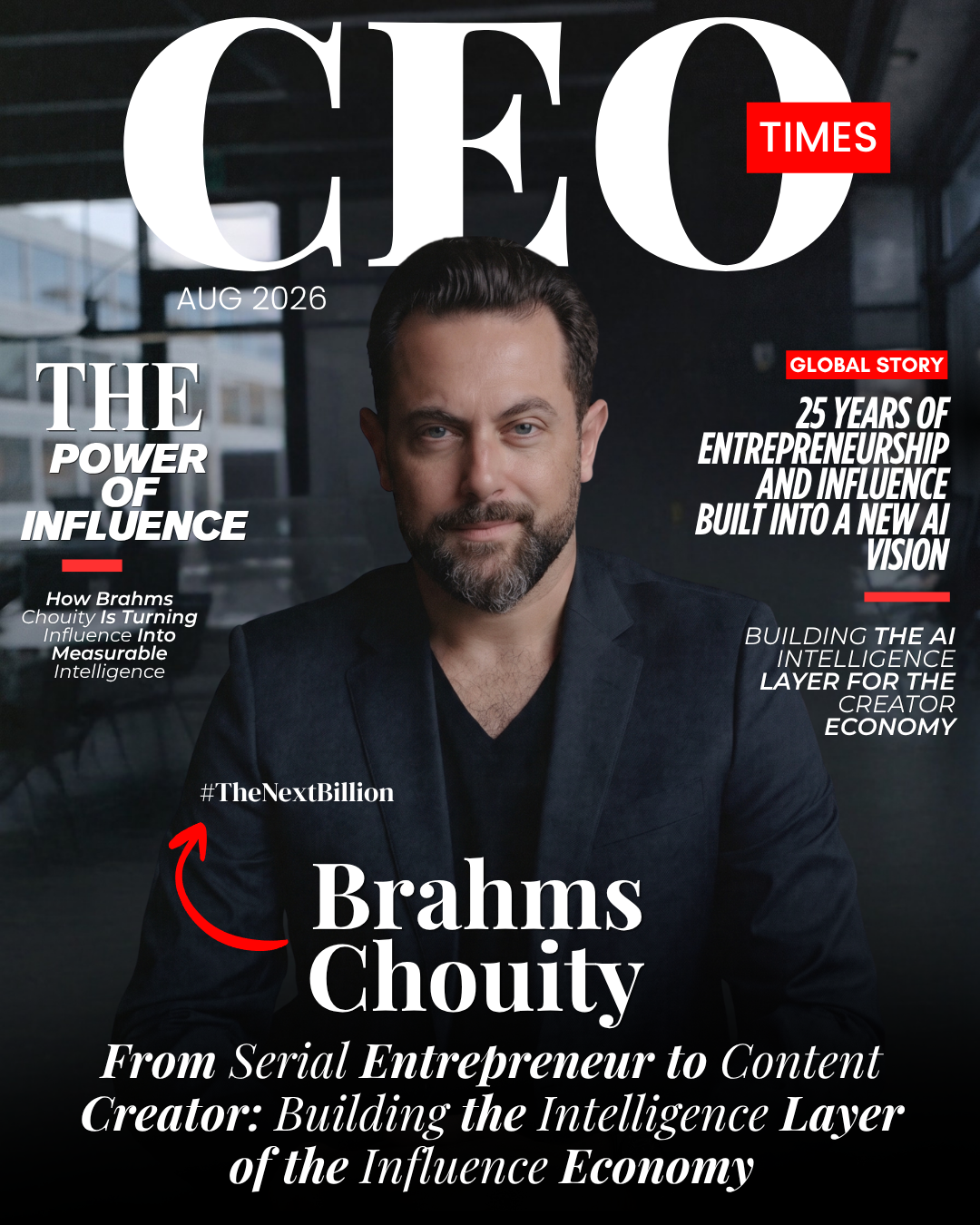
Most entrepreneurs spend their careers learning how to build companies. Most creators spend theirs learning how to build audiences.
Brahms Chouity has spent decades doing both.

That combination has given the Australian-Lebanese entrepreneur an unusually informed view of the creator economy. For more than 25 years, Chouity has built and participated in ventures across hospitality, media, publishing, gaming, lifestyle, consulting, fintech, cryptocurrency, technology, and other sectors. Alongside that entrepreneurial career, he spent roughly a decade developing his own identity as a digital creator, building an audience of approximately 500,000 followers and collaborating with hundreds of brands.
He understands how companies think about growth, acquisition, budgets, and return on investment.
He also understands how creators build authority, shape perception, attract attention, and turn audiences into commercial opportunity.
Today, those two sides of his career have converged in fyuze, an AI-powered platform created to address a question that has become increasingly important as the creator economy matures:
How do you measure real influence?
For Chouity, that question exposes one of the industry’s biggest weaknesses. Brands spend heavily on creator partnerships, yet many decisions are still based on relatively simple indicators such as follower counts, engagement rates, views, and reach.
Those metrics can describe visibility.
They do not necessarily explain influence.
And that distinction is the foundation of his latest company.
Twenty-Five Years of Building
Chouity’s entrepreneurial journey began long before startup culture became part of popular identity.
Raised in Saudi Arabia and educated across Switzerland, Australia, and Lebanon, he developed an early interest in business, consumer behavior, branding, and the mechanisms that determine why some ideas create value while others disappear.
Over the following decades, he became involved in more than 50 ventures.
The industries changed constantly.

Luxury lifestyle management. Private banking. Hospitality. Restaurant development. Publishing. Esports. Motorsports. User-generated content platforms. Technology. Artificial intelligence. Fintech. Cryptocurrency.
What remained consistent was his interest in building.
Some ventures succeeded. Others became lessons.
Collectively, they gave him something difficult to acquire through theory alone: perspective.
“I started building businesses 25 years ago,” Chouity recalls. “Back when digital marketing meant sending a proposal by fax and hoping it arrived on the other side of the world unsmudged. No WhatsApp. No Instagram. No Zoom. No Slack. No creator economy.”
Each company became an opportunity to understand markets more deeply.
How customers make decisions.
Why distribution matters.
Why strong products can fail.
Why positioning can sometimes matter as much as product development.
Why attention can accelerate almost every other component of a business.
Across industries, one observation became increasingly difficult to ignore.
Attention was a multiplier.
A company could have an excellent product, experienced leadership, capital, and infrastructure, but without sufficient attention, growth remained difficult.
At the time, few could have predicted how dramatically technology would transform the economics of attention.
Then social media arrived.
When Individuals Became Distribution Channels
Social platforms fundamentally changed who could command an audience.
Distribution was no longer controlled exclusively by television networks, newspapers, magazines, entertainment companies, and established media institutions.
An individual with a smartphone could potentially reach millions.
Influence became decentralized.
For many traditional business leaders, social media initially appeared superficial.
Chouity saw something else.
He saw a new distribution system.
Rather than observing it from the outside, he entered the ecosystem himself.
He launched DaddyFoody, initially as a lifestyle and food-focused social project.
What began casually grew into a recognizable digital platform.
Over the following years, Chouity collaborated with hundreds of brands, traveled extensively, developed a community of approximately 500,000 followers, and received recognition including the World Blogger Awards.
To outside observers, it may have looked like an entrepreneur had abandoned business for influence.
In reality, the entrepreneur had never left.
“The entrepreneur in me was studying the entire time,” Chouity says. “I wasn’t just creating content. I was observing how influence worked. Why people followed. Why they trusted. Why some creators drove action while others generated noise.”
That observation would eventually become important.
Chouity had positioned himself inside two industries simultaneously.
He was a founder who understood creators.
And a creator who understood founders.
The Difference Between Attention and Influence
As influencer marketing expanded, Chouity began noticing a structural weakness.
The industry was growing rapidly, but many of the systems used to evaluate creators remained relatively unsophisticated.
Brands looked at followers.
Agencies analyzed likes.
Campaigns were compared using views.
Engagement rates became shorthand for performance.
Each metric offered useful information.
But Chouity believed the industry was confusing attention with something far more valuable.
Influence.
Attention means someone has been seen.
Influence means someone can affect perception or behavior.
A creator may generate millions of impressions yet have limited ability to change purchasing decisions.
Another creator may have a smaller audience but command extraordinary trust within a specific community.
On a spreadsheet, the first creator may appear more powerful.
Commercially, the second may be considerably more valuable.
“I realized something uncomfortable,” Chouity says. “Nobody actually knew who was influential. Not really. Everyone was making educated guesses.”
For someone who had spent years on both sides of creator partnerships, the problem looked increasingly significant.
Billions were flowing into a market where one of its most important assets remained difficult to measure.
Is Influence Becoming an Asset Class?
Oil once defined industrial power.
Capital defined financial expansion.
Data became one of the defining resources of the digital economy.
Chouity believes influence now deserves to be considered within the same conversation.
Brands compete for it.
Social platforms monetize it.
Politicians seek it.
Media organizations depend on it.
Creators turn it into businesses.
Consumers make decisions because of it.
Influence can move products, shape reputations, build movements, accelerate companies, and change public perception.
Yet compared with financial markets, its measurement infrastructure remains relatively immature.
That creates consequences.
Brands may overpay for creators whose audiences lack relevance.
High-value creators may be overlooked because traditional metrics underestimate them.
Agencies can spend significant time manually analyzing profiles.
Marketing budgets may be allocated using incomplete information.
Fraudulent engagement and inflated metrics can further complicate decision-making.
Chouity believes this gap becomes more serious as the market expands.
“Everybody is an influencer now,” he says. “My dad has an Instagram account, my kids have followers, your dentist probably has a podcast. Millions of creators. Billions of data points. More content than any marketer can process.”
At that scale, human judgment alone becomes increasingly limited.
That is where fyuze enters the story.
Building fyuze
Many influencer marketing companies focus primarily on access.
They build creator databases.
Campaign marketplaces.
Communication systems.
Search platforms.
Chouity wanted to approach the market differently.
Instead of simply helping companies find creators, he wanted to help companies understand them.
The result is fyuze, a London-based platform positioned around AI-powered creator intelligence.
The platform is designed to analyze social media accounts and help brands, advertisers, and agencies evaluate creators using a broader range of signals.
Rather than relying only on followers or basic engagement metrics, fyuze is intended to examine factors such as audience demographics, authenticity, engagement quality, growth patterns, brand alignment, account performance, sentiment, and other relevant indicators.
Users can search through prompt-based queries and apply AI-assisted analysis to identify potential creators for campaigns.
The objective is straightforward:
Move influencer marketing from intuition toward intelligence.

From simple discovery toward deeper evaluation.
From raw data toward context.
“We don’t need more data,” Chouity says. “The world is drowning in data. What we need is context, analysis, and intelligence.”
That philosophy sits at the center of fyuze.
Beyond Another Influencer Platform
Chouity’s ambition is not to build another directory.
He wants fyuze to become what he describes as the intelligence layer of the creator economy.
That distinction changes the size of the opportunity he is pursuing.
The financial industry has Bloomberg.
Enterprise businesses have sophisticated intelligence and analytics platforms.
Search transformed the internet by organizing information at scale.
Chouity believes the creator economy is approaching a similar stage of development.
As influence becomes increasingly important commercially, businesses will require better infrastructure for understanding it.
“The next Bloomberg won’t track the financial market,” he argues. “It will track influence.”
It is intentionally ambitious positioning.
But it reflects how Chouity sees the market.
He does not believe creator marketing is merely a branch of advertising.
He sees the creator economy as part of a larger structural shift in how trust, attention, recommendation, identity, and commercial persuasion are created.
And infrastructure tends to emerge whenever an economic system becomes large enough.
The Double Agent
The idea behind fyuze is inseparable from Chouity’s own professional identity.
He describes himself as a Double Agent because he has operated meaningfully on both sides of the creator economy.
For brands, he understands budgets, business objectives, brand positioning, customer acquisition, and measurable outcomes.
For creators, he understands storytelling, audience psychology, engagement, presentation, and the mechanics of digital perception.
That dual perspective also makes him acutely aware of how online success can be misunderstood.
“I’ve spent decades using content to grow businesses, so I know exactly what brands want,” he says. “And I’ve spent years as a creator, so I know exactly how creators manipulate perception. Those two worlds combined have turned me into a Double Agent.”
It is not simply branding.
It explains the thesis behind his company.
Surface-level metrics can be engineered.
Perception can be managed.
Follower counts can be misleading.
High engagement does not automatically equal high commercial influence.
Understanding creators therefore requires considerably more context than a profile page can provide.
Chouity believes AI can help uncover that context.
The Creator Economy’s Intelligence Problem
The creator market has grown faster than much of the infrastructure supporting it.
Millions of creators publish content across multiple platforms.
Brands operate across countries, languages, industries, demographics, and audience segments.
Trends can change within days.
New personalities can emerge almost overnight.
Meanwhile, marketers are expected to identify the right creator, for the right audience, at the right time, while managing reputation risk and demonstrating return on investment.
The complexity is enormous.
Traditional spreadsheets and manual analysis can only go so far.
Chouity believes AI becomes particularly valuable when the challenge is not acquiring more information, but interpreting enormous amounts of existing information.
For fyuze, the opportunity lies in turning millions of disconnected signals into useful commercial intelligence.
Who is credible?
Whose audience is authentic?
Which creator fits a particular brand?
Who is growing organically?
Who carries reputational risk?
Who commands attention but little persuasion?
Who may be undervalued by conventional metrics?
These are the questions Chouity believes the next generation of creator technology must answer.
From Attention to Intelligence
The first era of social media was dominated by audience size.
The second emphasized engagement.
The next may be defined by understanding.
As the creator economy matures, businesses are likely to demand increasingly sophisticated ways of evaluating partnerships.

Follower counts alone are no longer enough.
Neither are likes.
Neither are views.
The underlying relationship between a creator and an audience is more complex.
Trust matters.
Context matters.
Demographic relevance matters.
Sentiment matters.
Brand compatibility matters.
Behavior matters.
The ability to influence action matters.
Chouity believes the company that can organize these signals effectively could occupy an important position inside the future creator economy.
That is the role he wants fyuze to play.
From Founder-Funded Startup to Global Ambition
Chouity says fyuze has been developed with founder funding and has already moved beyond the idea stage into an operational, revenue-generating business.
That early commercial activity gives him something many emerging technology companies spend years attempting to establish: initial market validation.
The next stage is expansion.
Chouity is now exploring relationships with strategic investors and venture capital firms that can support fyuze’s international ambitions.
The objective is not simply to sell more subscriptions.
It is to establish fyuze as infrastructure.
If the creator economy continues growing and brands increasingly seek sophisticated intelligence around creators, Chouity believes the opportunity could become considerably larger than campaign management alone.
Influence itself could become a measurable commercial data category.
And whoever builds the trusted intelligence around that category could become increasingly valuable.
Twenty-Five Years. One Larger Bet.
Chouity has built more than 50 ventures over the course of his entrepreneurial career.
He has worked across industries that appear disconnected until viewed through a wider lens.
Hospitality taught him experience.
Publishing taught him distribution.
Branding taught him perception.
Technology taught him scalability.
Social media taught him attention.
Influencer marketing taught him trust.
Artificial intelligence now gives him the opportunity to bring those lessons together.
That is why fyuze may represent his most personal startup.
It is not based on a trend he discovered through market research.
It is built around a problem he experienced directly for years.
He has been the entrepreneur purchasing attention.
He has been the creator selling it.
Now he wants to build the intelligence capable of explaining its value.
The Future Belongs to Those Who Understand Influence
History repeatedly creates new forms of economic power.
The industrial age rewarded control of production.
The internet age rewarded control of information.
Social media rewarded control of attention.

The next stage may reward those capable of understanding influence.
Chouity believes that influence is becoming too valuable, too complex, and too economically important to continue being measured through simple assumptions.
For him, that is the larger opportunity behind fyuze.
The company is not attempting to create influence.
Creators already do that.
It is attempting to make influence more understandable.
More measurable.
More actionable.
And ultimately more valuable.
After 25 years as an entrepreneur and approximately a decade living inside the creator economy, Brahms Chouity has arrived at a conclusion that now defines his largest bet:
Attention is easy to see.
Influence is much harder to understand.
And in an economy increasingly shaped by trust, recommendation, and individual authority, understanding that difference may become one of the most valuable capabilities a company can build.
For Brahms Chouity, the next chapter is not about becoming more influential.
It is about building the system that explains who truly is.